
Sports Broadcasting Jobs: What the Work Involves and How to Get Started

By Riley Knox
Sports broadcasting jobs cover much more than commentary. A live programme needs people to capture pictures, balance sound, check information, prepare repl
Sports broadcasting jobs cover much more than commentary. A live programme needs people to capture pictures, balance sound, check information, prepare replays and keep the output running. The useful starting question is which part of that work you can learn to do reliably under live conditions.
Choose a direction before building a portfolio or applying. Someone assessing a camera operator needs different evidence from someone hiring a researcher. Understanding that distinction helps you spend your practice time on work relevant to the role.
Who does what on a sports production?
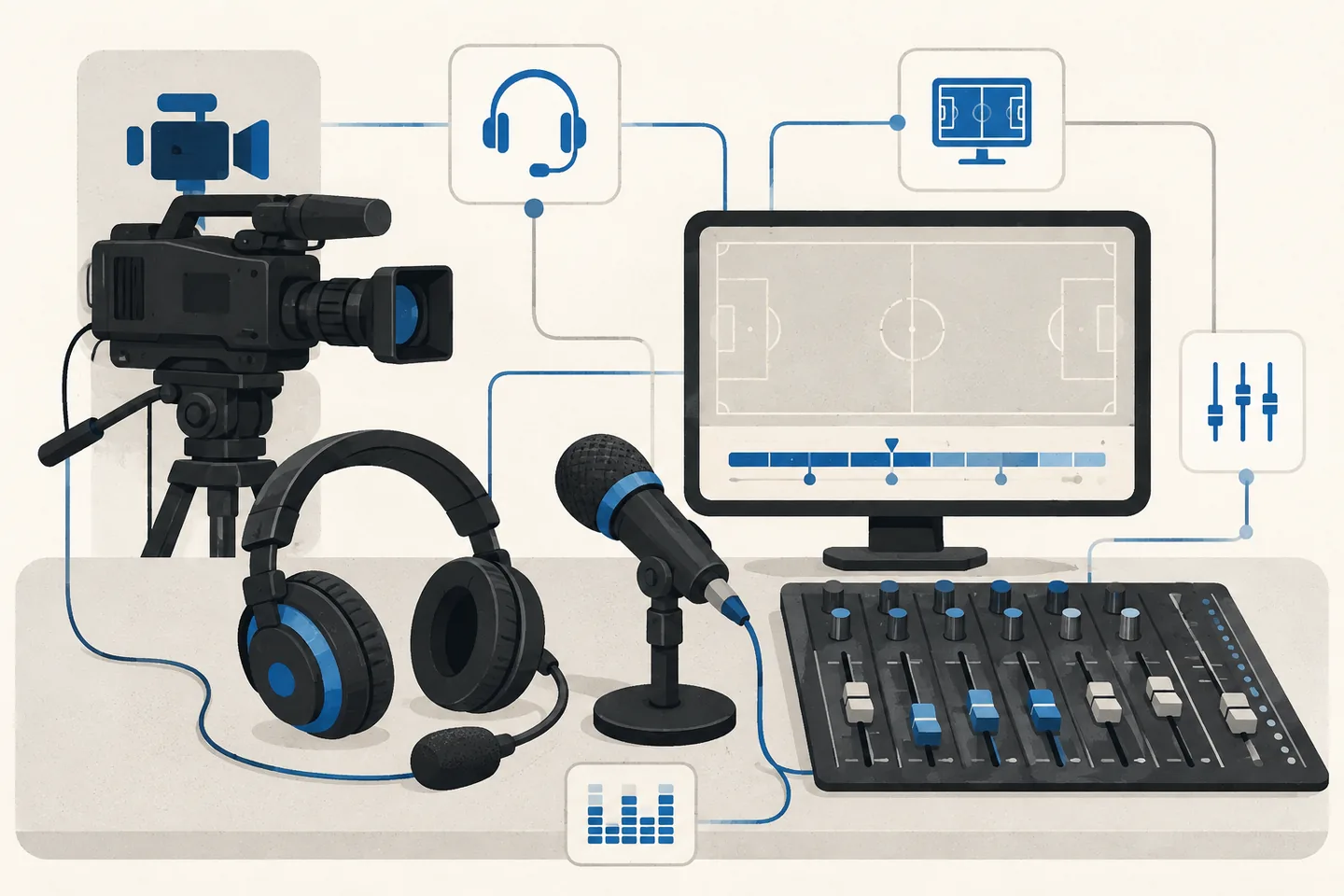
A live sports production brings together cameras, microphones, graphics, commentary, replays and distribution. The EBU’s live-production guidance provides a technical reference for understanding how these elements connect. The main areas of work include:
- Production: Producers shape coverage; directors call shots and sequences; coordinators organise people, schedules and practical arrangements.
- Camera and vision: Camera operators follow the action, vision mixers select pictures, and vision engineers check image consistency and signal quality.
- Audio: Sound teams manage commentary, interviews and atmosphere so speech remains intelligible without losing the sense of the event.
- Replay and highlights: Operators identify important moments, label recordings and prepare sequences for immediate playback or later editing.
- Graphics and data: Operators prepare scores, names, line-ups and statistics, checking information before displaying it.
- Commentary and reporting: Presenters, commentators and reporters explain the action, prepare interviews and supply relevant context.
- Engineering and distribution: Technicians set up, monitor and troubleshoot the equipment and connections carrying the programme to its audience.
Titles and boundaries vary. A small production may combine duties that a larger team assigns to specialists. The occupational overview from the Bureau of Labor Statistics describes technical work across broadcast, sound and video. Read each vacancy for its actual responsibilities rather than relying on the title.
Match the role to your strengths
If you enjoy equipment and fault-finding, investigate audio, engineering or broadcast operations. Search related titles such as technician, control operator and production engineer. These roles can involve monitoring signals, maintaining equipment, keeping logs and reporting faults.
If you prefer research and quick editorial decisions, look at researcher, logger or production assistant roles. Camera, editing, replay and graphics suit different forms of visual judgement. Commentary requires clear explanation, careful listening and preparation; enthusiasm for a sport alone does not demonstrate those skills.
Consider the whole working day. Camera work can involve moving equipment and sustained concentration. Technical staff may spend substantial time setting up and testing before coverage starts. Production staff handle changing timings and instructions. Ask about travel, shift patterns, physical tasks and supervision when assessing a position.
Practise the foundations
For technical work, learn signal flow: where a picture or sound originates, how it reaches the mixing equipment and where it goes next. Draw a simple setup, label its connections and practise tracing a missing signal. Develop safe cable management and equipment handling through supervised work.
For production and editorial roles, practise research, fact-checking, interview questions and running orders. A running order should identify each segment, its expected duration and the material or contributor it needs. Keep confirmed information separate from details still awaiting verification.
For camera and editing roles, record a short sequence with a clear beginning, development and ending. Check framing, continuity and sound before adding effects. For replay practice, log key moments with timestamps and descriptive labels, then find them again against a time limit.
For graphics, create a readable scoreboard and a set of name captions. Test long names and changing scores, including how you would correct an error. For commentary, record a short passage and listen back for accuracy, unnecessary repetition and whether your words help someone follow the action.
Across every role, practise concise communication. A useful fault report identifies the affected source, the symptom and what has already been checked. Listen through instructions before replying, acknowledge your task and flag uncertainty early enough for someone to act.
Gain experience with a defined responsibility
Local clubs, educational productions, community stations and small event teams are places to investigate supervised practice. Ask about a specific task rather than offering to do anything. Operating one camera or logging one match gives you a clearer learning objective than an undefined supporting role.
Before agreeing, establish the expected hours, your duties, who supervises you and whether the arrangement is paid or voluntary. Confirm what equipment you will use and what preparation is expected. Be honest about tasks you have practised and those you would need help to perform.
Afterwards, review concrete questions. Were your cues clear? Could the interviewer and interviewee both be heard? Did your labels let an editor find the right moment? Choose one weakness to address in the next exercise and keep notes showing what changed.
Build a portfolio that shows your contribution
A portfolio should make your work easy to assess. Select relevant samples and explain the assignment, your responsibility and any constraints. Where several people contributed, distinguish your part from the team's finished output. Label practice exercises as exercises.
- Editorial: Include a research sheet, interview plan or short script with clearly organised information.
- Technical: Show a setup diagram, checking sequence and a brief account of a fault you diagnosed.
- Creative: Present a short edit, camera sequence or graphics sample and explain the decisions behind it.
- On air: Provide a concise commentary or interview sample with enough context to understand the task.
Use material you have permission to share. Do not assume that helping on a production lets you publish its footage or internal documents. Where access is restricted, describe the workflow without disclosing private information, or create a separate practice sample.
Understand editorial responsibility
Accuracy matters in captions and pictures as well as spoken commentary. Check names, scores and context, and know who should receive a correction. Avoid filling gaps with guesses about a participant's motives, personal circumstances or condition.
Fairness, privacy and commercial references also require editorial judgement. Ofcom’s current Broadcasting Code is a reference for regulated television and radio. In a production role, establish which editorial rules apply to the service and who handles difficult decisions.
Camera choices should serve the sporting story and respect participants. The EBU’s “Raising the Bar” guidance addresses respectful coverage. Review whether a shot helps explain skill, tactics or the event, and raise concerns about intrusive framing with the responsible producer.
Technical discipline supports that responsibility. Clear labels, accurate logs and prompt escalation help colleagues locate material and investigate mistakes. Shared technical specifications also matter because equipment and systems must work together; learn the terminology relevant to your chosen role.
Prepare a focused application
Compare several descriptions for one role and list the repeated requirements. Match each requirement to evidence you already have or a manageable practice task. Treat a gap honestly: distinguish training, supervised experience and work you can perform independently.
In your application, describe what you did and how you checked it. Preparing interview questions and verifying names is stronger evidence than claiming excellent research skills. Link directly to the relevant sample, explain your contribution briefly and check that the file opens without special access.
For an interview, prepare one example of responding to a changed plan or technical problem. Explain the situation, your action and what you learnt. Ask who gives instructions during a live production, how new staff are supervised and which skills the team expects you to develop first.